
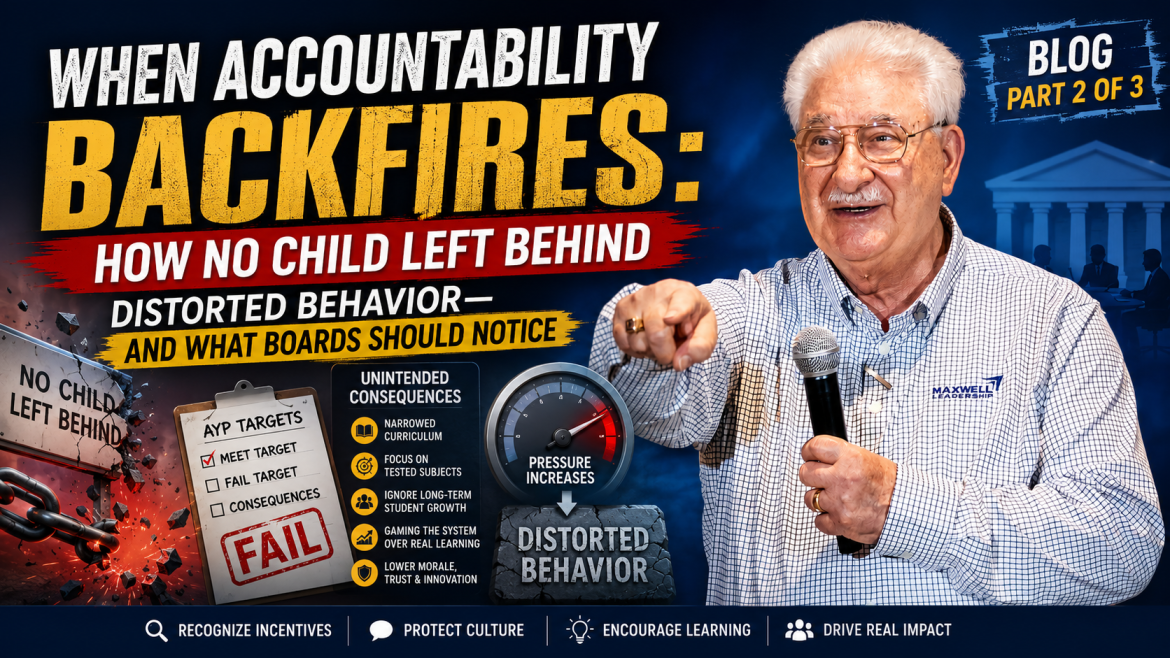
Accountability is not neutral. It shapes behavior, sometimes in ways we neither anticipate nor intend.
In the first part of this series we discussed “No Child Left Behind, accountability, metrics, governance, and lessons for association leaders.”
No Child Left Behind did not falter because it lacked rigor. It faltered because it underestimated how systems respond to pressure. ¹ In the first part of this series, the central warning was that metrics can quietly become proxies for mission. The next lesson is even more important: once accountability systems are attached to consequences, they do not just measure behavior; they begin to shape it.
At the center of NCLB was Adequate Yearly Progress, or AYP, a mechanism designed to ensure continuous improvement. Schools that failed to meet targets faced escalating consequences. ² On paper, the logic was straightforward: define expectations, measure progress, and attach consequences when progress stalls.
From a governance standpoint, that formula is deeply familiar. Associations do this all the time. Boards adopt strategic goals, define success indicators, and ask executives to demonstrate movement. That is not inherently problematic. Accountability matters. Clarity matters. Consequences, in some circumstances, matter too. But NCLB revealed a critical weakness in many accountability systems: they often assume that people will respond to pressure exactly as intended. They rarely do.
The Pressure Cascade
Under NCLB, accountability flowed downward: federal expectations shaped state systems, which in turn shaped district decisions, which ultimately shaped school behavior, which ultimately shaped what happened in classrooms.² Each level translated policy into operational pressure.
This kind of cascade is common in associations as well: board goals, CEO performance metrics, staff objectives, program design, and member experience. At every step, something subtle happens. Measures that begin as signals become directives. Targets that begin as aspirations become perceived requirements. What begins as oversight becomes, in practice, a shaping force on behavior. That matters because organizational actors rarely respond only to mission. They are also responding to risk. When people believe their standing, funding, evaluation, or credibility depends on certain outcomes, they understandably orient their behavior around those outcomes. This is not a character flaw. It reflects how the system itself shapes their behavior.
The Predictable Emergence of Gaming
Critics, including Diane Ravitch, the National Education Policy Center, the National Education Association, the American Federation of Teachers, and legal and policy scholars, documented how schools adapted to NCLB’s incentives. Common responses included narrowing instruction to tested subjects, directing disproportionate attention to students near proficiency cutoffs, and managing indicators in ways that improved reported performance more readily than actual learning.¹ ³ ⁴ ⁵
These outcomes were often described as “gaming the system,” but that phrase can obscure a more important truth: the system was producing rational responses to its own design. That is a lesson executives and board members should take seriously. When associations create strong incentives around a small set of visible outcomes, similar distortions can emerge:
- Programs may be built for speed rather than depth.
- Short-term participation may be favored over long-term member development.
- Leaders may highlight what is easily counted while underinvesting in what is mission-critical but harder to quantify.
- Teams may avoid surfacing early warning signs because bad news can look like underperformance.
In other words, accountability systems do not simply monitor behavior. They organize it. Association Leaders may believe it is asking for performance. The organization may experience that request as pressure to produce favorable indicators at any cost.
The Cost to Culture
One of the most consistent critiques from educator organizations was the effect of punitive accountability on morale, trust, and professional judgment. The AFT argued that high-stakes testing had eclipsed broader educational purposes and had not accomplished ESEA’s intended goals.⁶ AFT statements and policy positions also emphasized that test-and-punish accountability narrowed curricula, displaced richer learning goals, and encouraged disproportionate attention to students just below passing thresholds.⁷
That critique resonates strongly in association life. When accountability becomes punitive:
- Trust erodes.
- Candor declines.
- Innovation becomes riskier.
- Compliance starts to replace commitment.
And once that culture takes hold, leaders begin receiving cleaner reports and weaker truth. That may be the most dangerous failure mode of all. A board or executives that creates fear may still receive dashboards, updates, and confident presentations. What it loses is not information volume. It loses information quality. Staff and volunteer leaders become less likely to disclose uncertainty, failed experiments, local context, or structural barriers that need attention.
Culture is not collateral damage. It is the medium through which the organization actually produces performance.
The Adaptive Leadership Gap
NCLB also reflected a deeper design problem. It treated educational equity: a profoundly complex and adaptive challenge, as though it were primarily a technical problem that would be solved through stronger measurement and stricter consequences.¹ ² But adaptive challenges do not yield easily to technical control.
Educational inequity, like association relevance, member trust, or leadership pipeline development, is shaped by multiple forces interacting at once. These challenges involve values, behavior, context, and learning. They require experimentation, not just enforcement. Associations often make the same mistake when they face declining membership, uneven chapter vitality, weak volunteer pipelines, or shifting professional expectations. The board’s instinct may be to add more reporting, define tighter targets, and increase oversight. Sometimes that helps. Often it does not. When the underlying challenge is adaptive, more pressure can actually reduce the learning capacity needed to solve it.
A Governance Question Worth Asking
Every accountability system encodes a set of incentives. The real board question is not:
“Are we measuring performance?” It is: “What behaviors are we rewarding and what behaviors are we suppressing?” That second question is harder. It requires association leaders to examine second-order effects, not just first-order outcomes.
A Practical Example
Imagine a board that ties executive compensation heavily to annual membership growth. The predictable outcomes are not difficult to foresee:
- Aggressive acquisition campaigns
- Discounting strategies that may weaken long-term value perception
- Less attention to retention, belonging, and experience
- Overstatement of near-term wins and underreporting of structural concerns
Year one may look successful. Year three may reveal erosion. The system worked exactly as designed. It just did not serve the deeper purpose the board thought it was advancing.
Reframing Accountability
Accountability should drive alignment, not distortion. To do that, boards and executives must:
- Examine incentive effects before adopting performance systems
- Monitor for unintended consequences, not just intended outcomes
- Create room for honest reporting without reflexive punishment
- Distinguish between technical underperformance and adaptive complexity
NCLB did not lack accountability. It lacked adaptability.⁸
For associations, that raises the real governance challenge. If pressure-heavy systems can narrow behavior, suppress candor, and reward surface performance over deeper value, then the work is not simply to demand accountability. It is to design accountability systems that preserve rigor while strengthening learning.
Next week’s final blog in this series is “The lesson of No Child Left Behind is not that accountability fails, it is that poorly designed accountability systems do.
Footnotes
- Diane Ravitch and allied policy critics argued that test-based accountability produced harmful unintended consequences and failed to generate the improvements its advocates promised.
- Analyses of NCLB describe how Adequate Yearly Progress and escalating consequences structured the law’s accountability model from the federal level down to classrooms.
- The National Education Policy Center summarizes research showing that test-based reforms encouraged narrowing of instruction and other counterproductive responses to high-stakes accountability.
- Legal and policy analyses of NCLB identified “perverse incentives” created by the law’s design, including incentives to focus on threshold students and on reported performance measures.
- Reviews of NCLB and related accountability systems note that high-stakes pressure often changed behavior in ways that improved metrics more readily than learning.
- The AFT argued that annual test-based accountability under NCLB “didn’t work” and that high-stakes testing eclipsed broader educational purpose while failing to achieve ESEA’s intended goals.
- AFT policy statements describe a test-and-punish accountability system that narrowed the curriculum, sacrificed learning time, and focused attention on students just below passing scores.
- Ravitch later called for a new paradigm of accountability after concluding that more than a decade of NCLB-style reform and subsequent Race to the Top policies had failed.