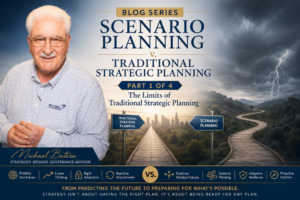
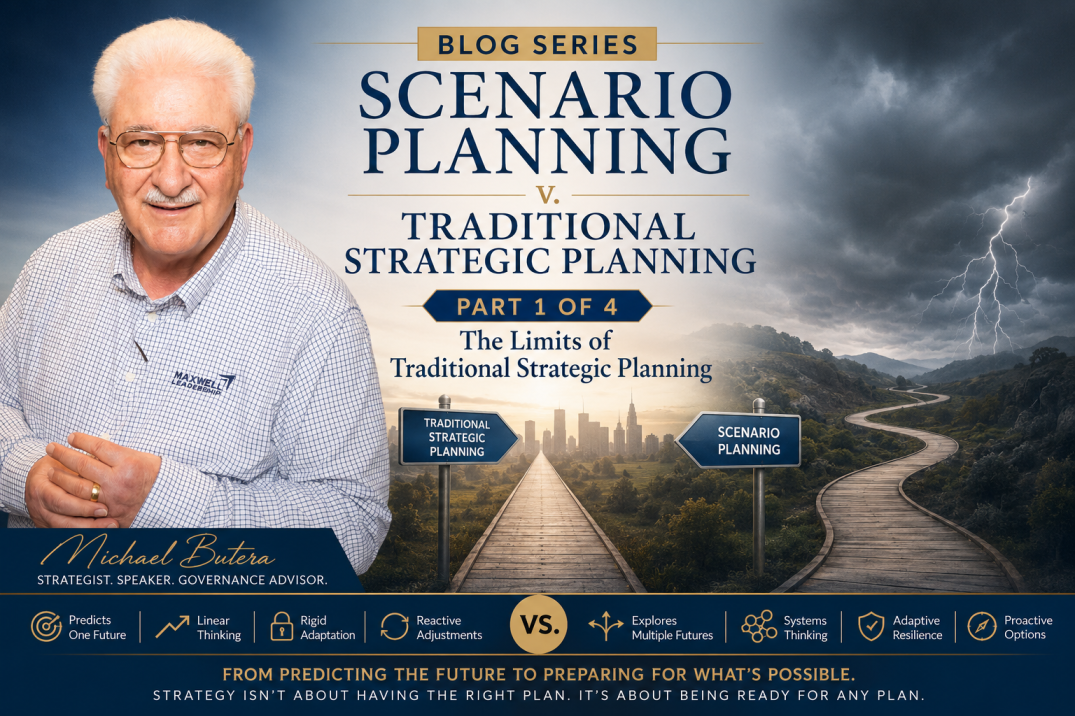
BLOG Series – Scenario Planning v. Traditional Strategic Planning
Scenario Planning v. Traditional Strategic Planning
For decades, strategic planning has served as the backbone of organizational direction. It has provided structure, discipline, and a shared sense of purpose. Boards approve strategic plans with the expectation that they will guide priorities, allocate resources, and anchor decision-making over a multi-year horizon. And for a time, that model worked. It worked in environments where change was incremental, where trends could be reasonably projected, and where the future, while uncertain, was not fundamentally unstable. Strategic planning was built on a core premise: that the future could be anticipated with enough data, analysis, and expertise. That premise no longer holds.
Why Traditional Strategic Planning Is Breaking Down
Today’s operating environment is defined less by steady evolution and more by discontinuity. Political polarization reshapes regulatory landscapes with little warning. Technological shifts accelerate faster than governance cycles can adapt. Social expectations evolve in real time, often driven by forces outside an organization’s direct field of view. Economic shocks ripple globally with increasing frequency.
In this context, the traditional strategic plan, carefully constructed, board-approved, and designed to guide three to five years of activity, often begins to erode almost immediately after it is finalized. This planning is not a failure of discipline. It is a mismatch between method and environment.
Traditional strategic planning relies heavily on linear thinking. It assumes that by analyzing past trends and current conditions, leaders can project forward with reasonable confidence. It privileges convergence, aligning around a single vision of the future and organizing the enterprise to pursue it. But when the future is not singular, when multiple plausible outcomes exist, this approach creates fragility. Organizations become overcommitted to a specific pathway. When conditions shift, and they inevitably do, leaders are forced into reactive adjustments rather than proactive adaptation.
Boards, in particular, feel this tension. Governance structures are designed for oversight, accountability, and stewardship. Yet when the underlying plan becomes misaligned with reality, the board’s role becomes more complicated. Do they hold management accountable to a plan that no longer fits? Or do they pivot, potentially undermining the very discipline they are meant to uphold? Thus, here is where scenario planning begins to offer a fundamentally different path.
How Scenario Planning Offers a Different Path
Scenario planning does not attempt to predict a single future. Instead, it acknowledges uncertainty as a defining condition and prepares organizations to operate within it. Rather than asking, “What will happen?” it asks, “What could happen and how would we respond?” This shift has profound implications.
First, it reframes uncertainty from a problem to be solved into a condition to be navigated. Traditional planning treats uncertainty as a gap in knowledge, something to reduce through better data or analysis. Scenario planning treats uncertainty as irreducible. It cannot be eliminated, only explored.
Second, it expands the strategic conversation. Instead of converging quickly on a preferred future, leaders deliberately examine multiple plausible futures. These are not predictions, but structured narratives shaped by key uncertainties—political, economic, technological, and social forces that could evolve in different directions.
Third, it changes how organizations think about preparedness. Success is no longer defined solely by executing a plan, but by the ability to perform across a range of conditions. For boards, this represents an evolution in governance. Oversight is no longer just about ensuring alignment to a fixed strategy. It becomes about ensuring the organization is resilient, adaptable, and aware.
A Real-World Example: Membership Growth Under Disruption
Consider a common scenario: an association develops a strategic plan centered on membership growth through expanded professional development offerings. The plan is well-researched, aligned with historical trends, and approved with confidence. Now introduce a set of plausible disruptions: a rapid shift to AI-driven learning platforms, regulatory changes affecting credentialing, or a generational shift in how professionals engage with associations.
Under a traditional model, these disruptions trigger mid-course corrections—often reactive and fragmented. Under a scenario planning model, these possibilities would have been explored in advance. The organization would have already considered how its strategy performs under each condition, where it is vulnerable, and where it has options. The difference is not just tactical—it is cognitive.
Building a Mindset for Uncertainty
Scenario planning cultivates a mindset that is comfortable with ambiguity. It encourages leaders to hold multiple possibilities simultaneously, to challenge assumptions, and to recognize that today’s certainties may not hold tomorrow. This mindset is increasingly critical at the board level. Governance decisions—from resource allocation to program approval thresholds—are made within an environment that is more dynamic than ever. Without a framework for exploring uncertainty, boards risk anchoring decisions in outdated assumptions.
There is also a cultural dimension. Traditional strategic planning often reinforces a bias toward confidence and clarity. Plans are presented in a coherent, logical, and well-supported manner. Deviations can be perceived as failures. Scenario planning, by contrast, normalizes uncertainty. It creates space for questioning, for exploring contradictory views, and for acknowledging that the future may unfold in unexpected ways. This shift in thinking does not weaken leadership—it strengthens it by making it more adaptive.
Conclusion: Evolving How We Plan
None of this suggests that strategic planning should be abandoned. Structure, alignment, and prioritization remain essential. But the method must evolve. The question for today’s boards and executives is not whether to plan, but how to plan in a way that reflects the realities of the environment.
Scenario planning offers one answer. Not as a replacement for strategy, but as an enhancement. Not as a one-time exercise, but as an ongoing discipline. It shifts the organization from seeking certainty to building capability. And in a world where certainty is increasingly elusive, that shift may be the most strategic decision of all.
Reflection questions:
- Where has our current strategic plan already drifted away from what is actually happening, and how quickly did that drift show up?
- What assumptions underpin our strategy, and which of them have we not explicitly tested?
- How often do board discussions challenge the validity of those assumptions rather than reinforce them?
- Are we designing strategies for a stable environment that no longer exists?
- What would governance look like if we prioritized adaptability as much as alignment?
Let me know what you think.