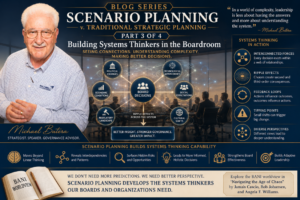
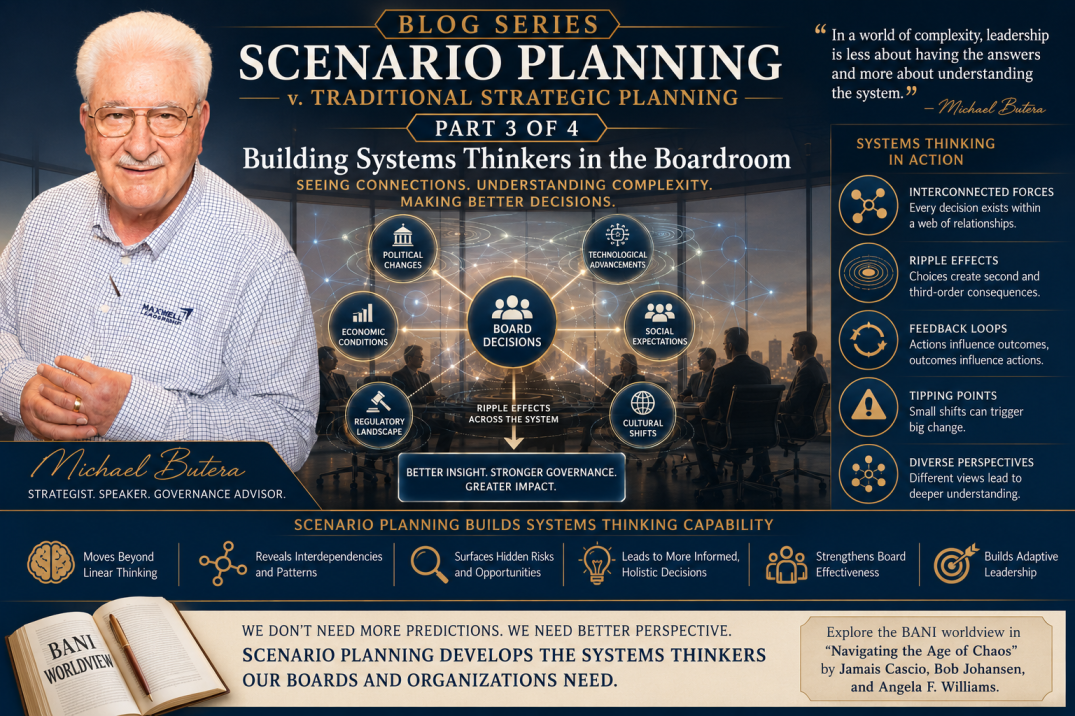
One of the most underappreciated outcomes of scenario planning is its impact on how leaders think. Not just what they decide, but how they understand the world in which those decisions are made. I have become a strong believer in the BANI worldview. I hope you will find time to explore the BANI concept more deeply. (see “Navogating the Age of Chaos,” by Jamais Cascio, Bob Johnansen, and Angela F. Williams).
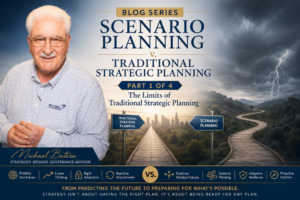
Traditional strategic planning tends to encourage linear thinking. It breaks complex challenges into discrete components: market trends, financial projections, operational goals, and addresses them individually. While this approach provides clarity, it can also obscure the interconnected nature of the systems in which organizations operate.
Scenario planning shifts this perspective. By design, it requires participants to consider how multiple forces interact. Political changes influence economic conditions. Technological advancements reshape social expectations. Cultural shifts affect regulatory priorities. These interactions are not additive; they are dynamic and often nonlinear.
Engaging with scenarios forces leaders to grapple with this complexity. They begin to see that decisions do not occur in isolation. A choice in one area can produce ripple effects across the organization and beyond. These second and third-order impacts are often where the most significant risks and opportunities reside, and they are at the heart of systems thinking.
For boards, developing this capability is critical. Governance challenges are increasingly systemic. Issues such as workforce dynamics, technological disruption, and stakeholder trust cannot be addressed through isolated interventions. They require an integrated understanding of how the system’s different elements interact. Scenario planning provides a practical pathway to build this understanding.
During scenario development, participants map out relationships between key drivers. They explore how changes in one variable influence others. They examine feedback loops, unintended consequences, and tipping points. This process does more than generate scenarios; it rewires how participants think.
Board members who engage in scenario planning often report a shift in perspective. They become more curious, more questioning, and more attuned to complexity. They are less likely to accept simple explanations and more likely to explore underlying dynamics; thus, having direct implications for governance. Board discussions become richer and more nuanced. Instead of focusing solely on immediate outcomes, conversations expand to include broader implications. Decisions are evaluated not just on their direct impact, but on how they interact with the broader system. For example, a decision to launch a new member service might traditionally be evaluated based on projected demand and financial return. A systems-oriented perspective would also consider how that service interacts with existing offerings, how it affects member expectations, influences staff capacity, and positions the organization within its broader ecosystem.
This deeper analysis leads to more informed decisions. It also reduces the risk of unintended consequences. Many organizational challenges arise not from poor intentions but from an incomplete understanding of how different elements interact. Systems thinking helps mitigate this risk by encouraging a more holistic view.
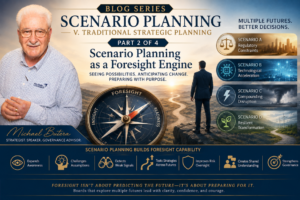
As mentioned in Part 2 of this series, it is also a cultural benefit. Scenario planning creates a space where diverse perspectives are not only welcomed but necessary. Different participants bring different insights into how the system operates. By integrating these perspectives, the organization develops a more comprehensive understanding, which is particularly valuable at the board level, where diversity of thought is a key asset.
Scenario planning leverages that diversity. It moves beyond surface-level agreement and encourages deeper exploration. It challenges assumptions, surfaces disagreements, and ultimately leads to more robust conclusions. Over time, this strengthens the board’s effectiveness.
It also aligns with the principles of adaptive leadership. In complex environments, leadership is less about providing definitive answers and more about facilitating learning, experimentation, and adaptation. Systems thinking supports this by enabling leaders to navigate complexity with greater confidence. Importantly, this capability is not developed solely through theory. It requires practice.
Scenario planning creates that practice ground by giving leaders a structured yet flexible space to wrestle with complexity, experiment with ideas, and sharpen their thinking. For associations and other mission-driven organizations, this is particularly important. A wide range of external forces often shapes their operating environments: policy, public perception, member needs, and technological change. Understanding how these forces interact is essential for effective governance. Scenario planning helps bridge the gap between awareness and understanding. It moves leaders from recognizing that complexity exists to actively engaging with it. And in doing so, it builds a board that is not only informed but insightful.
Reflection questions:
- Where are we oversimplifying complex challenges in our governance discussions?
- How often do we consider the broader system in which our decisions operate?
- Are we identifying and exploring second and third-order impacts of our choices?
- How effectively are we exploring and using diverse perspectives within the board?
- What steps can we take to strengthen systems thinking as a core leadership capability?
Let me know what you think.