

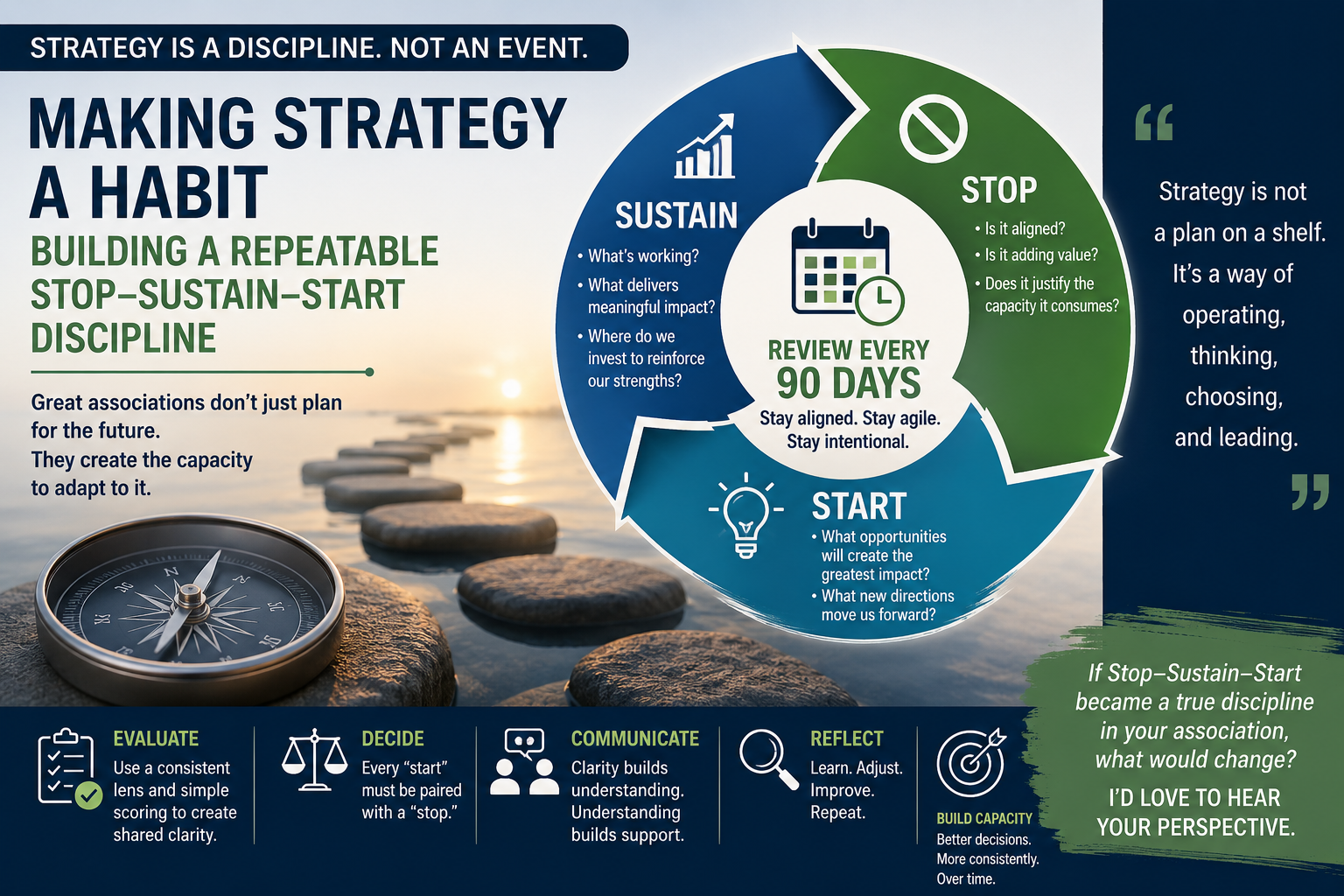
At this point in the conversation, we have named the hard truth.Strategy is not defined by what we say yes to.It is defined by what we are willing to leave behind.But here is where many associations stumble.They treat Stop–Sustain–Start as an event.A retreat exercise. A planning moment. A difficult conversation that happens once… and then fades.And then, six months later, the same pressures return.The same overload.The same lack of Clarity.Because nothing structural has changed, and little actual strategic or system thinking has occurred in the discussions. So let me offer a different way to think about this:
Stop–Sustain–Start is not a decision.It is a discipline.
Like any discipline, it requires a process.Not a complicated one.A consistent one.Let me walk you through what that can look like in practice.It begins with cadence.
If your organization only makes strategic choices once a year, you are already behind. The environment is moving too fast.I suggest a simple rhythm: every 90 days, pause and reassess.90 days may not be special or fixed, but it provides a disciplined approach.Not everything. Not all at once. But enough to stay aligned with what is changing around you.
Now, this is where your infrastructure—your capacity—begins to show up.Because the next step is evaluation.The Board and the Executive can begin to see that every program, project, event, or campaign (your PPEC framework- see earlier posts) will be seen through a consistent lens:
- Is this still aligned with where we are going?
- Is it delivering meaningful value?
- Does it justify the capacity it consumes?
Thinking and acting this way is not about perfection. It is about Clarity.And here is where I encourage something many organizations avoid:Use a simple scoring approach.Not to reduce decisions to numbers, but to create shared understanding. A 1–6 scale, for example, can quickly surface where energy and action areoccurring —and where they are not. I would avoid odd-numbered scales because it is too easy for many to check the fixed middle. We need to be progressing or not. It is old but true, because what gets measured gets discussed. And what gets discussed gets decided.Numbers are important, but do not forget the human touch.
From there, we move to the decision itself.Stop.Sustain.Start.
But here is the creative tension I want you to sit with:Every “start” must be paired with a “stop.”Not philosophically. Practically.If we are not willing to create space, we are not ready to move forward.Refusal to stop is where many organizations hesitate. But it is also where transformation begins. Once additionalresourcesbecome available, the stop may take a different form or adaptation. That is for further discussion.
And then comes the part that organizations and stewards often overlook:communication.Decisions without clarity create confusion. Clarity without communication creates resistance.So be explicit.Why are we stopping this?Why are we sustaining that?Why does this new direction matter?When people understand the “why,” they are far more likely to support the “what.”
Finally, and this is where the discipline becomes culture, we return to reflection.At the end of each cycle, ask:
- What did we learn?
- What did we get right?
- Where did we hesitate?
Over time, this is what builds strategic capacity—not a single decision, but the ability to make better decisions, more consistently. Now, strategy becomes infrastructure.Not a plan on a shelf.Not a moment in time.But a way of operating.A way of thinking.A way of choosing.And ultimately, a way of leading.
Let me leave you with a question.
If your association made Stop–Sustain–Start a true discipline—every 90 days, consistently—what would change?Not just in what you do… but in how you think?
I would appreciate your perspective.
What have you tried?What has worked?Where has it been difficult?Because this work is not theoretical.It is shared.
In our next post, we will discuss Measuring Strategic Capacity. See you then.