Scenario Planning as a Foresight Engine: How Boards Can Prepare for Multiple Futures
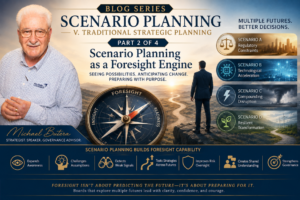
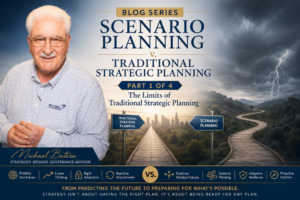
If traditional strategic planning is rooted in projection, scenario planning is rooted in perception. At its core, scenario planning strengthens an organization’s capacity for foresight—the ability to anticipate, interpret, and prepare for emerging changes before they fully materialize. For boards and executives, this capability is no longer optional. It is a prerequisite for effective governance.
What Is Scenario Planning in Governance?
Scenario planning disrupts the pattern of hindsight-driven governance by introducing a disciplined approach to thinking about the future. It begins by identifying key drivers of change; forces shaping the external environment. These may include political dynamics, technological advancements, demographic shifts, economic conditions, and cultural trends. Importantly, scenario planning distinguishes between predetermined elements (relatively certain things) and critical uncertainties (things that could evolve in multiple directions). It is within these uncertainties that scenarios are constructed.
Why Boards Rely Too Heavily on Hindsight
The Problem With Traditional Board Agendas
Most governance structures are heavily weighted toward hindsight and oversight. Board agendas are filled with financial reports, performance updates, and compliance reviews. Even when future-oriented topics are discussed, they are often framed within the boundaries of the existing strategy.
The Building Blocks of Scenario Planning
Predetermined Elements vs. Critical Uncertainties
Scenario planning distinguishes between predetermined elements (relatively certain things) and critical uncertainties (things that could evolve in multiple directions). It is within these uncertainties that scenarios are constructed.
Turning Uncertainties Into Plausible Future Stories
As mentioned in Part 1 of this series, rather than selecting the most likely outcome, leaders develop a small set of distinct, plausible futures. Each scenario represents a different configuration of how key uncertainties might resolve. The goal is not to be correct, but to be comprehensive.
These futures are written as stories, not a list of “to-dos” and “goals.” This process does something that traditional planning rarely achieves: it expands awareness by engaging with multiple futures. Leaders begin to see patterns and possibilities that would otherwise remain hidden. Risks that seemed remote become tangible. Opportunities that were previously overlooked come into focus. Assumptions that felt solid begin to loosen. This thinking is the essence of foresight—not prediction, but expanded perception.
A Real-World Example: Regulation and Technology Collide
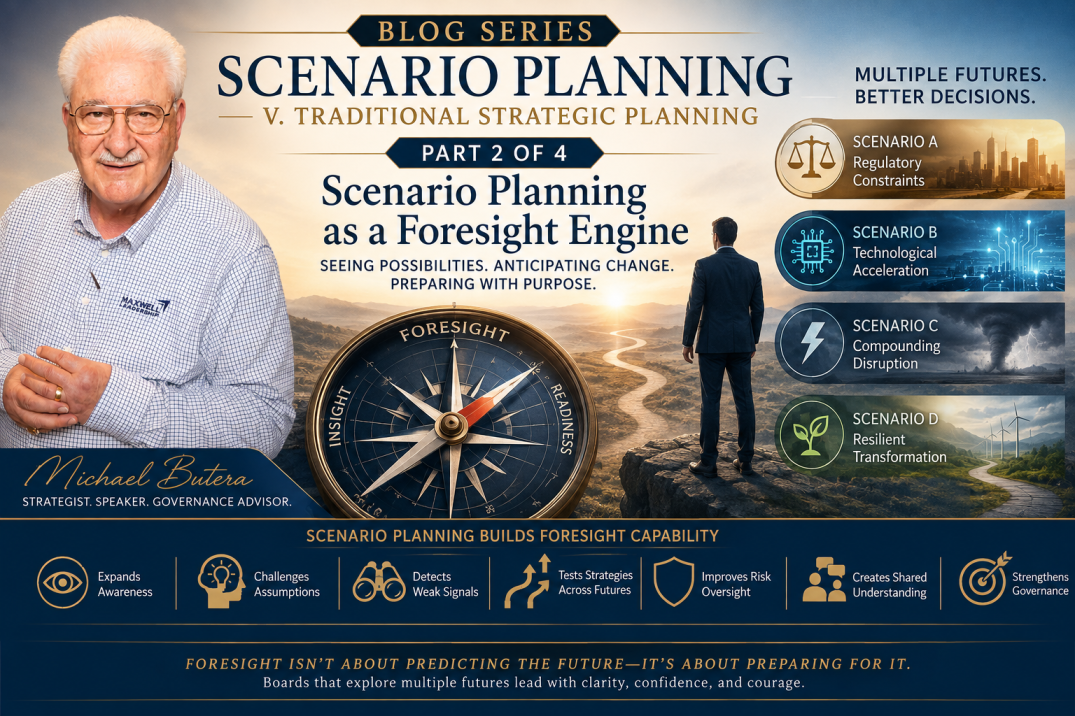
For example, consider an association operating in a field influenced by both regulatory policy and technological innovation. A traditional plan might assume moderate regulatory stability and incremental technological change.
Scenario planning would challenge those assumptions by exploring alternatives:
- What if regulation becomes highly restrictive?
- What if technology accelerates faster than anticipated?
- What if both occur simultaneously?
Testing Strategy Against Multiple Scenarios
Each scenario reveals different implications for strategy, operations, and member value. More importantly, it allows leaders to test their current approach against a range of conditions. This testing is where foresight becomes actionable. Strategies that perform well across multiple scenarios are more robust. Strategies that succeed in only one scenario but fail in others are more fragile. This insight enables leaders to refine their approach, build contingencies, and prioritize flexibility.
How Scenario Planning Strengthens Board Governance
For boards, this has direct governance implications. Foresight enhances the quality of decision-making. When approving major initiatives, boards can ask not only, “Does this align with our strategy?” but also, “How does this perform under different future conditions?”
Better Decision-Making Under Uncertainty
Foresight enhances the quality of decision-making. When approving major initiatives, boards can ask not only, “Does this align with our strategy?” but also, “How does this perform under different future conditions?”
Expanding Risk Oversight Beyond the Known
It also improves risk oversight. Traditional risk management often focuses on known risks with quantifiable probabilities. Scenario planning broadens this view to include emerging and uncertain risks, those that may not yet be fully visible but could have a significant impact.
Creating a Shared Language for the Future
Perhaps most importantly, scenario planning creates a shared language for discussing the future. In many organizations, conversations about the future are fragmented. Different leaders hold different assumptions, often unspoken. Scenario planning makes those assumptions explicit and provides a structured way to explore them collectively. This shared understanding strengthens alignment not around a single forecast, but around a range of possibilities.
Building Long-Term Foresight Capabilities
There is also a developmental aspect. Engaging in scenario planning builds foresight capabilities within the leadership team and the board. Participants become more attuned to external signals, more comfortable with uncertainty, and more skilled at integrating diverse perspectives. Over time, this shifts the organization’s posture. It becomes less reactive and more anticipatory.
From Reactive to Anticipatory Leadership
Consider how this plays out in practice. An organization that has engaged in scenario planning is more likely to recognize early indicators of change. It has already identified key uncertainties and defined signals to monitor. When those signals begin to emerge, the organization is not starting from scratch; it is activating insights that have already been developed.
This level of thinking is a critical advantage in a fast-moving environment. The ability to respond quickly is often less about the speed of execution and more about the speed of recognition. Scenario planning accelerates that recognition. It also supports better resource allocation. By understanding how different futures might unfold, leaders can make more informed decisions about where to invest, build flexibility, and maintain optionality.
As you will see in this series, scenario planning helps boards and executives develop new systems and strategic thinking skills.
Why This Matters More for Associations
For associations, this is particularly relevant. Resources are often constrained, and decisions must balance immediate member needs with long-term positioning. Scenario planning provides a framework for navigating these trade-offs with greater clarity.
Ultimately, scenario planning transforms foresight from an abstract concept into a practical capability. It does not eliminate uncertainty. It does not provide definitive answers. What it does is prepare leaders to engage with uncertainty more effectively. And in doing so, it elevates the role of governance. Boards are no longer just stewards of the present; they become active participants in shaping the organization’s readiness for the future.
Reflection Questions for Your Next Board Meeting
- What are the most critical uncertainties facing our organization, and how explicitly have we defined them?
- How often do our board discussions include structured exploration of future scenarios?
- Are we relying too heavily on a single view of the future?
- What signals or indicators are we actively monitoring to detect change?
- How can we regularly embed foresight into our governance processes?
Let me know what you think.