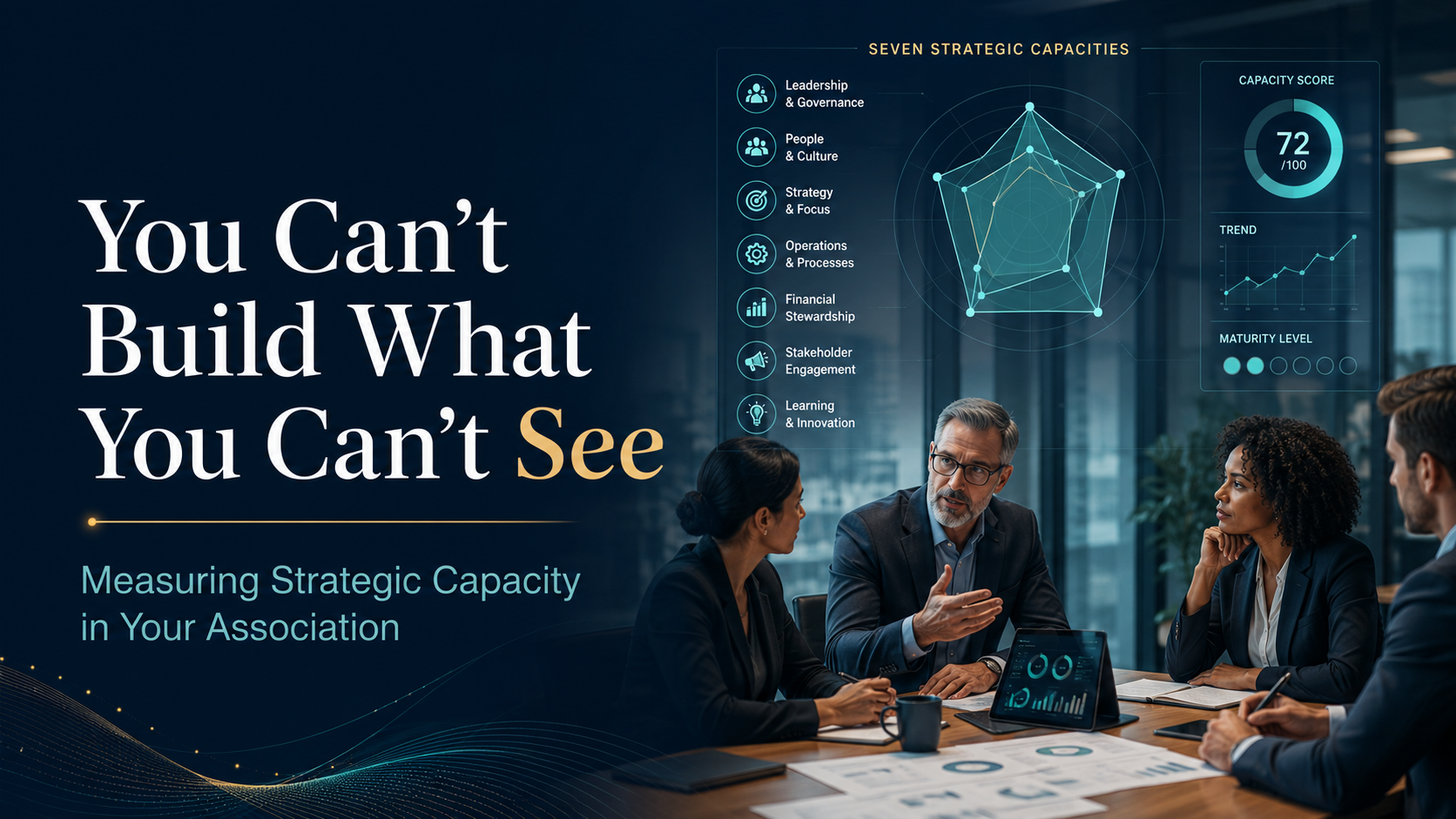
Let me offer a simple observation.Most associations don’t have a strategy problem.They have a thinking and visibility problem.They don’t actually know where their capacity is strong…Where it is inconsistent. Or where it is quietly breaking under pressure.So they do what many organizations do. They plan. They prioritize. They push forward with the best intentions—only to find that execution lags, progress stalls, and the same challenges resurface.Not because the strategy was wrong.Because they failed to build the capacity to deliver on the strategy, it was never fully understood.
If we accept the premise we have been building throughout this series—that infrastructure is capacity, and capacity is what drives results—then the next step becomes clear:We have to make capacity visible.And that begins with measurement.
Now, let me be clear. I am not talking about more dashboards filled with activity metrics. Most associations already have those. Reports on attendance, revenue, engagement, and outputs.Those tell us what has happened.They do not tell us whether we are capable of what comes next.
What we need is something different.We need a way to assess our ability to sense, decide, and act—consistently and under changing conditions —and this is where a Strategic Capacity Diagnostic becomes essential.
Across the Seven Strategic Capacities, we can begin to ask:
- How strong is our curiosity and strategic thinking—our ability to understand what is changing?
- How effective is our governance and foresight—our ability to anticipate and prepare?
- How reliable is our operational integrity—our ability to execute with trust and discipline?
- How well do we deliver programs that truly create value?
- How strong is our reputational impactin the environments that matter?
- How sustainable is our resource development?
- And do we have the talent and technology to support all of the above?
You don’t need perfect precision to begin answering these questions.In fact, I often suggest something simple—a shared scoring approach. A 1–6 scale, for example, is used by both board and staff. Not to create artificial certainty, but to surface patterns.Because patterns tell a story.
An organization may score high in program delivery but low in foresight—delivering well today, but unprepared for tomorrow. Another may have strong governance but weak technology—clear direction but limited execution.This is where insight begins to take shape.
Example: The Capacity Alignment Ratio.
Take your top 5 strategic priorities for the next 12 months.Then ask a simple question:“Do we currently have the capacity to execute this well?”Score each priority on a scale of 1–6:
- 1–2 = Low capacity (are we stretched or unprepared?)
- 3–4 = Moderate capacity (we can execute, but with risk)
- 5–6 = Strong capacity (we are well-positioned)
Now average the scores.
- 5.0–6.0 → Aligned: Your capacity supports your ambition
- 3.0–4.9 → At Risk: Execution will be inconsistent
- Below 3.0 → Misaligned: Strategy is exceeding capacity
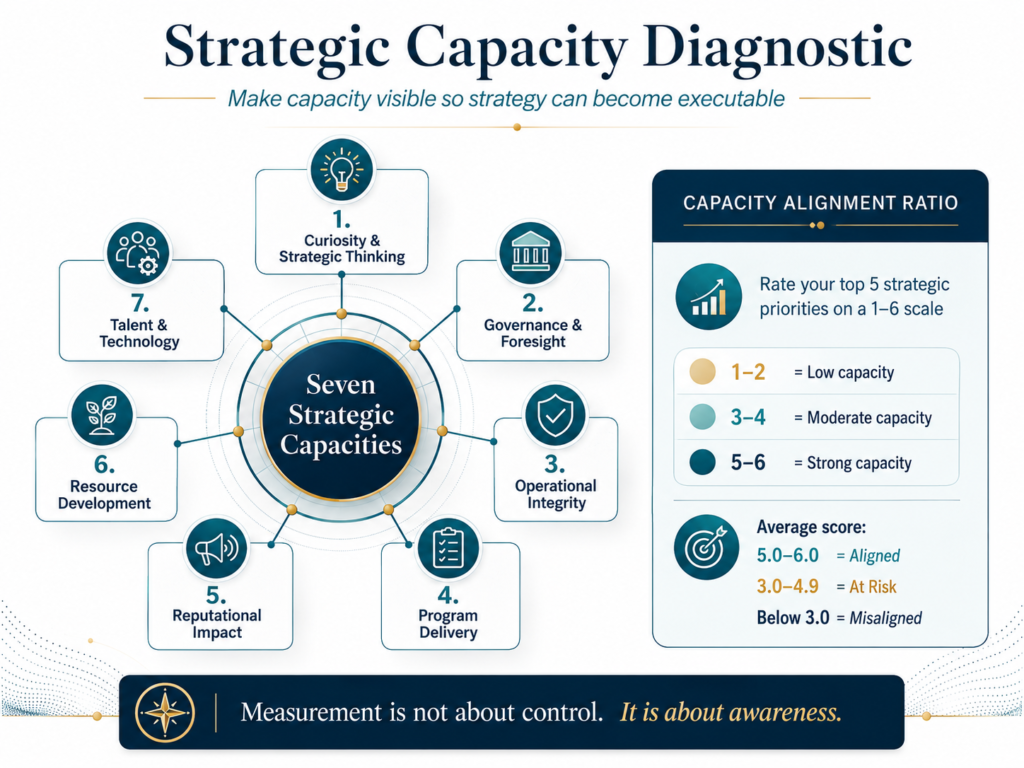
This Capacity Ratio idea is not complicated.But it is revealing.Because it forces a conversation most organizations avoid:Are we trying to do more than we are actually capable of doing well?And if the answer is yes, then the issue is not effort.It is alignment and where insight begins to take shape.
And here is the shift I want you to consider:Measurement is not about control.
It is about awareness.When leaders can see capacity clearly, conversations change.They move from assumptions to understanding.From isolated issues to systemic patterns.From reactive fixes to intentional investment.Thus, strategy begins to connect with reality, and the conversations add the necessary human touch to numbers.
Once you can see your capacity, you can begin to build it.Deliberately. Consistently. Over time.Not by trying to fix everything at once, but by focusing on what matters most—where a shift in capacity will create meaningful impact.
That is the work.And it leads us to the next step.How do we take this awareness and translate it into a practical, ongoing system for building capacity—quarter by quarter, decision by decision? But clearly over an established timeframe.
Because seeing clearly is powerful.But building consistently…That is what changes everything.
Let me know what you think. Email me