In an environment where the lines between nonprofit and for-profit are increasingly blurred, the ultimate challenge is not survival. It is imperative. What need is there for a nonprofit organization in a world where alternatives are abundant, expectations are rising, and traditional advantages are eroding? It begins with a shift in orientation.
Many organizations have been built to endure—to preserve mission, sustain operations, and maintain continuity over time. These are important objectives, but they are no longer sufficient. Endurance without evolution leads to irrelevance. Organizations are not defined by their longevity. They are defined by their ongoing ability to create meaningful, distinctive values aligned with their purpose.
This requires leadership at both the executive and governance levels that is willing to embrace uncertainty, challenge assumptions, and make deliberate choices about the future. I like Jeff De Cagna’s concept of “next practices” is instructive here. Rather than focusing solely on improving current practices, organizations must explore what will be required to thrive in the future. This involves asking different kinds of questions.
- What emerging needs are not yet being fully addressed?
- What capabilities will be required to meet those needs?
- What changes must we make now to be ready for what comes next?
These questions shift the focus from optimization to transformation.
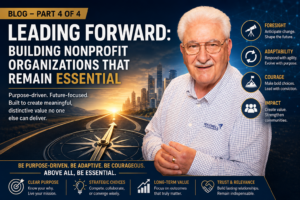
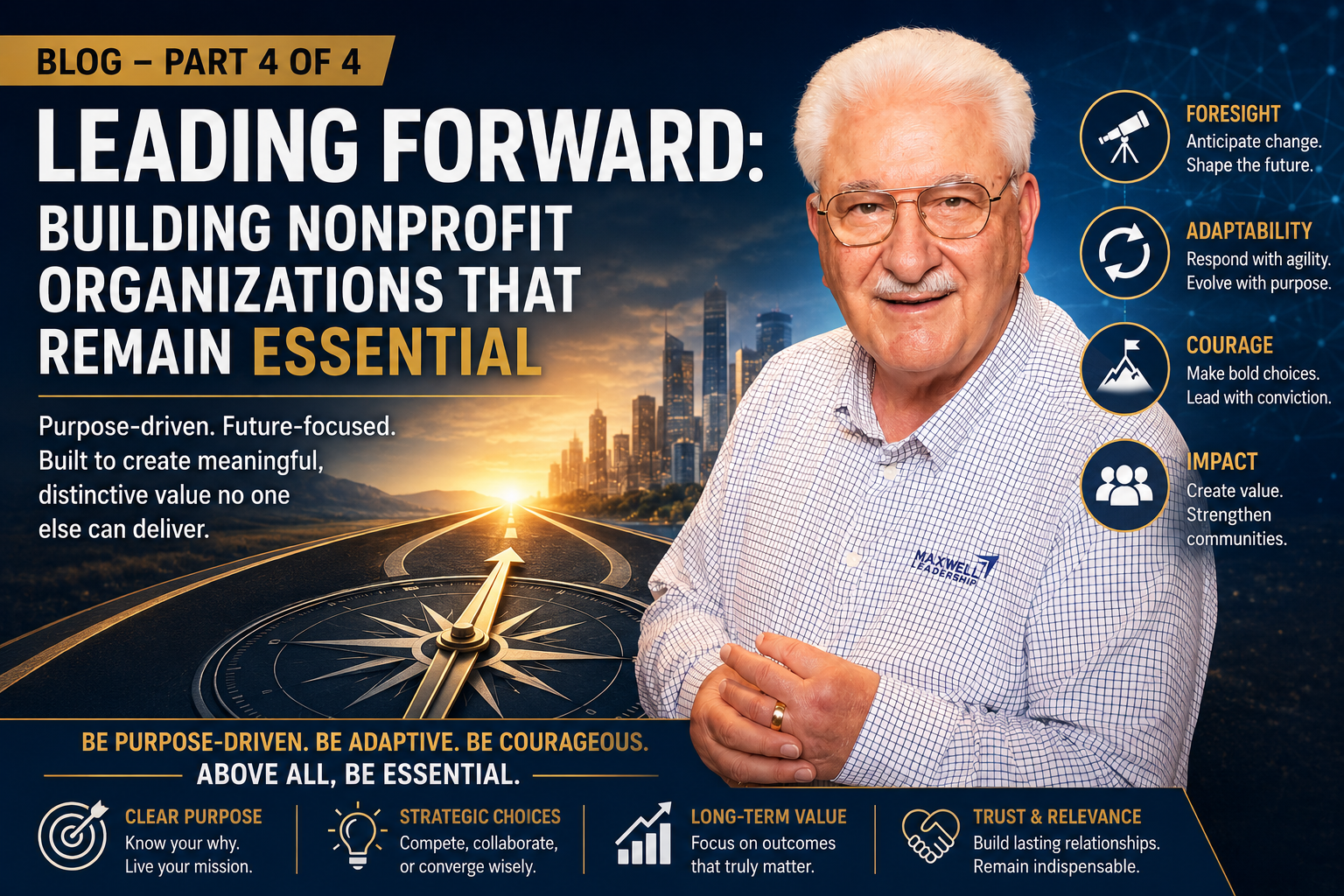
Simon Sinek’s emphasis on purpose provides the anchor mentioned several times in this series. The “why” remains the organization’s north star, but it must be translated into actions that resonate in a changing environment. This translation requires three core capabilities: foresight, adaptability, and courage.
Foresight enables organizations to anticipate change rather than react to it. This does not mean predicting the future with certainty but exploring plausible scenarios and considering their implications. Consider shifting from the traditional strategic planning approach to adopting a scenario approach. Scenarios help in developing a foresight mindset that traditional strategic planning appears to have lost. For example, what happens if for-profit platforms become the primary gateway for professional development? What role does a nonprofit play in that ecosystem? How does it maintain visibility, credibility, and influence?
Adaptability is the ability to respond to changing conditions with agility and intentionality. This includes not only operational flexibility but also cultural openness to change. Organizations that are overly attached to legacy models may find it difficult to adapt, even when the need is clear.
Courage is perhaps the most critical capability. It is the willingness to make decisions that may be uncomfortable, controversial, or uncertain. This might involve investing in new areas while scaling back others. It might involve redefining the organization’s value proposition. It might involve challenging long-held assumptions about what the organization is and what it does. Courage is not about taking risks for their own sake. It is about making choices that are aligned with purpose, even when they are difficult. Leadership in this context is not confined to individuals. It is a collective responsibility.
Boards, executives, staff, and stakeholders all play a role in shaping the organization’s trajectory. Creating alignment among these groups is necessary. This requires clear communication, shared understanding, and a commitment to ongoing dialogue.
It also requires metrics that reflect what truly matters. Traditional performance indicators—revenue, membership numbers, program participation—remain important, but they may not fully capture the organization’s impact or relevance. Organizations should consider how they measure outcomes such as community engagement, trust, influence, and long-term value creation. These are more difficult to quantify, but they are critical indicators of essentiality.
Technology also plays a central role. For-profit entrants often excel in leveraging technology to enhance user experience and scale their offerings. Nonprofits must be equally intentional in how they use technology to advance their mission. This does not mean adopting every new tool or trend. It means making strategic choices about where technology can create meaningful value. For example, digital platforms can expand access to education, facilitate community building, and enable more personalized engagement. When aligned with purpose, these capabilities can strengthen the organization’s impact.
Finally, there is the question of identity. As the sector evolves, nonprofits must reconsider how they define themselves. Are they primarily providers of services? Conveners of communities? Advocates for change? Stewards of a profession? The answer may be all the above, but clarity is essential.
Identity shapes strategy, and strategy shapes outcomes. Organizations that are clear about who they are—and who they aspire to be are better positioned to make coherent decisions in a complex environment. The entry of for-profit entities into the nonprofit space is not a temporary disruption. It is part of a broader transformation in how value is created and delivered. Nonprofits that recognize this and respond with intention will not only remain relevant but also become indispensable. Those who do not may find themselves competing on terms that do not favor them, struggling to articulate their value, and gradually losing their connection to the communities they serve.
The path forward is not easy, but it is clear. Be purpose-driven, but not purpose-bound. Be adaptive, but not reactive. Be courageous, but not careless.
Above all, be necessary in your stakeholders’ eyes. Because in the end, the organizations that matter most are not those that simply exist. They are those who make a difference in ways that no one else can.
Reflection for Part 4
- What does “essential ” mean for our organization, and how would we know if we were becoming less needed?
- Which outcomes matter most to our long-term relevance, not just our short-term sustainability?
- Which investments would strengthen our value five years from now?
- How are we building an organization that can adapt without losing its purpose?
I hope you have enjoyed this four-part series and have obtained some valuable options for your organization.
Let me know what you think.